


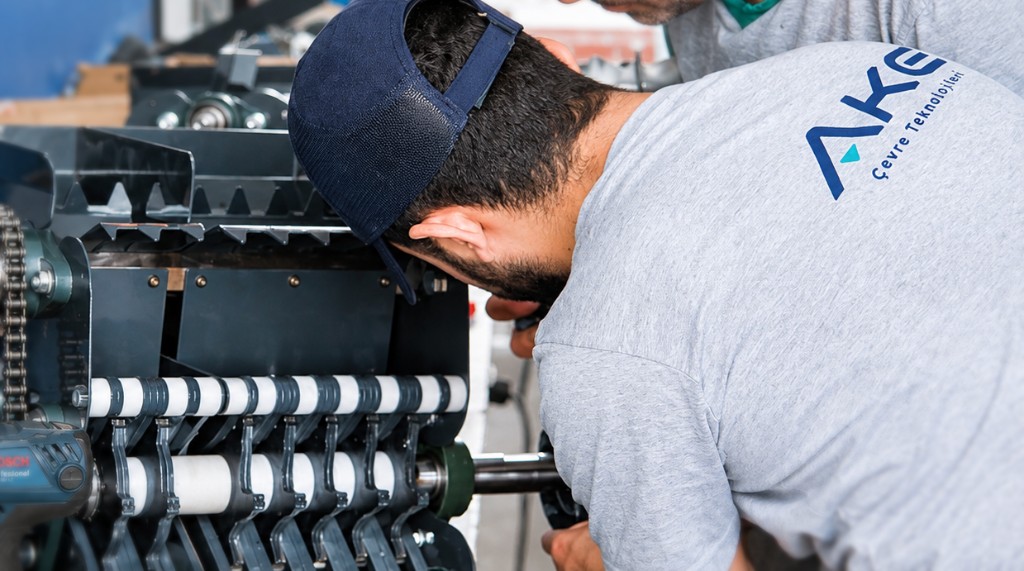
A price comparison is not enough
For a machinery brand, choosing the right manufacturing partner is not only a comparison of the quoted price. Reading drawings correctly, repeatable production, quality assurance, confidentiality, delivery discipline and spare-part continuity after shipment become decisive, especially on multi-component systems such as recycling equipment and deposit return machines.
For companies that sell machines under their own brand in Europe, Turkey is one production base that can be considered, because of its geographic proximity and a broad industrial supply network. Finding a suitable partner still means verifying the manufacturer’s real capability with documents and examples. The same search also appears as contract manufacturing Turkey, OEM machinery manufacturer, recycling machine contract manufacturer and reverse vending machine OEM supplier.
1. Ability to build to the drawing and the specification
The first question is not whether the manufacturer can copy an existing product. It is whether it can apply the customer’s drawings, tolerances, bills of materials and assembly instructions in a consistent way. Which of sheet-metal work, welding, surface treatment, mechanical assembly and the required electronic integration is done in-house, and which is done with approved subcontractors, should be stated openly. Prototype approval and series-production conditions are not the same.
2. Quality control and traceability
A contract manufacturer supplying Europe should be able to show measurement records, incoming inspection, checks on critical parts, final test procedures and nonconformity handling. Serial numbers, batches and revision tracking can limit a fault to one machine or one group of components. If a management-system certificate such as ISO 9001 exists, its scope and validity should be checked separately. The certificate on its own does not mean the product meets every technical rule.
3. A plan from prototype to series production
OEM and contract-manufacturing partnerships often start with a sample, a prototype or a pilot batch. A capable manufacturer defines, at the start, the sample date, first-article verification, revision cycles, supply of critical components and the thresholds for moving into series. For the European brand, the point is not only that the first machine works. The same quality level has to hold on later batches.
4. Intellectual property, brand confidentiality and the contract
In a contract-manufacturing model, design, software, drawings, the bill of materials and customer lists can be commercially sensitive. A confidentiality agreement, access to drawings, ownership of tools and fixtures, a ban on production for third parties, limits on brand use, and what happens to the files when the contract ends should be written down. The OEM manufacturer’s role is not to compete with the customer’s brand. It is to carry out the agreed scope of production reliably.
5. Sharing responsibility for European conformity
Which rules on machinery safety, electrical safety, electromagnetic compatibility and other requirements apply to a given product is a technical question. A CE mark on its own is not a general quality certificate. Who prepares the technical file, who runs the risk assessment and the tests, who signs the declaration of conformity, and who carries the legal duties of the manufacturer should be clear in the contract.
The European Union’s new Machinery Regulation (EU) 2023/1230 will apply from 20 January 2027. Current project plans should check the dates in force separately.
6. Lead time, logistics and total manufacturing cost
Beside the unit price, compare tooling and fixture cost, minimum order quantity, packing, transport, customs, currency risk, rework and the cost of delay. Turkey’s proximity to Europe can help on some routes. Delivery time still depends on the weight of the product, the route, the origin of bought-in parts and the customs conditions. Quotes should state the Incoterms, the production schedule and how delays will be communicated.
7. Spare-part continuity and a long-term partnership
On equipment that works in the field, such as recycling machines, the partnership does not end with the first shipment. Keeping revised parts lists, approving changed components, supplying service parts and holding parts available through the life of the product all matter. A European OEM brand should ask how the manufacturer manages engineering changes and how it records compatibility between old and new versions.
Extra points for recycling and deposit return machines
A reverse vending machine and similar equipment can include sensors, packaging-recognition units, moving mechanisms, user interfaces and, on some projects, networked control, as well as the mechanical body. Mechanical accuracy, cable routing, service access, tests after assembly and how the product holds up in different site conditions should be reviewed when the partner is chosen. Which subsystems sit inside the contract-manufacturing scope should be described at the start.
A production-partnership approach with AKE Çevre Teknolojileri
AKE Çevre Teknolojileri aims to develop OEM and contract-manufacturing cooperation with Europe-based brands in environmental technology and recycling machines. The focus is that European companies can keep their own brand and market relationships while assessing a manufacturing partner in Turkey. The actual scope should be set from the drawings, the quantity, the quality criteria, the delivery terms and the confidentiality needs of both sides.
If you are looking for a manufacturing partner in Turkey for a recycling machine or related mechanical subsystems, you can share the technical needs of the project with AKE Çevre Teknolojileri and discuss the possible scope. Manufacturing capability, the scope of any certificate, lead times and responsibility for the technical file should be confirmed for the project.
Sources
- European Union, Machinery Regulation (EU) 2023/1230: https://eur-lex.europa.eu/eli/reg/2023/1230/oj
Frequently asked questions
Are OEM production and contract manufacturing the same thing?
The terms overlap on some projects. OEM usually means making a product or component for another brand. Contract manufacturing means running production under the technical and commercial terms the parties set. The split of responsibility in the contract is what matters.
Does manufacturing in Turkey automatically mean compliance with European rules?
No. The rules that apply to the product, the tests, the documentation and the responsibilities still have to be assessed separately.
Which documents should you ask a contract manufacturer for in the first meeting?
A list of manufacturing capability, a sample quality plan, verifiable copies of relevant certificates, a sample schedule and the confidentiality terms are a useful start.
Can the machinery brand use its own logo?
Private-label or OEM branding is possible when the contract states it clearly, together with the technical and legal responsibilities.
Discuss the production scope for your project
Share the drawings, quantity, quality criteria, delivery terms and confidentiality needs. A possible OEM or contract-manufacturing scope is reviewed from that brief.